Embark on a journey through the scriptures with biblical scholar Kenny Sallee as your guide. With a Master's degree in Theology and a passion for biblical studies, Kenny offers insightful commentary, profound reflections, and enriching discussions. Whether you're a seasoned scholar or a curious seeker, this platform provides a space for deepening your understanding of the Bible and growing in faith. Join us as we explore the timeless truths of God's Word together.

Friday, October 29, 2021

Verse of the Day for Saturday, October 30, 2021


Verse of the Day
Saturday, October 30, 2021


Ephesians 2:8-9
For it is by grace you have been saved, through faith—and this is not from yourselves, it is the gift of God—not by works, so that no one can boast.
If our salvation were dependent upon our actions—if we could be redeemed by doing good works, keeping the commandments, and refraining from sin—we would always be in danger of losing it whenever we stumbled. However, because salvation is a gift given to us freely—and not in exchange for anything we can do—it is completely secure. Our salvation therefore magnifies the awesome love and grace of God alone, since He blesses us not because of our merit but because of His goodness.

Read all of Ephesians Chapter 2

Listen to Ephesians Chapter 2


Scripture from the Holy Bible, New International Version®, NIV®.

Our Daily Bread — A New Calling


A New Calling

He has saved us and called us to a holy life. 2 Timothy 1:9

READ 2 Timothy 1:6–14

Teenage gang leader Casey and his followers broke into homes and cars, robbed convenience stores, and fought other gangs. Eventually, Casey was arrested and sentenced. In prison, he became a “shot caller,” someone who handed out homemade knives during riots.

Sometime later, he was placed in solitary confinement. While daydreaming in his cell, Casey experienced a “movie” of sorts replaying key events of his life—and of Jesus being led to and nailed to the cross and telling him, “I’m doing this for you.” Casey fell to the floor weeping and confessed his sins. Later, he shared his experience with a chaplain, who explained more about Jesus and gave him a Bible. “That was the start of my journey of faith,” Casey said. Eventually, he was released into the mainline prison population, where he was mistreated for his faith. But he felt at peace, because “[he] had found a new calling: telling other inmates about Jesus.”

In his letter to Timothy, the apostle Paul talks about the power of Christ to change lives: God calls us from lives of wrongdoing to follow and serve Jesus (2 Timothy 1:9). When we receive Him by faith, we desire to be a living witness of Christ’s love. The Holy Spirit enables us to do so, even when suffering, in our quest to share the good news (v. 8). Like Casey, let’s live out our new calling. 

By Alyson Kieda

REFLECT & PRAY

When have you shared the gospel with someone, and what was the result? Did it ever lead to suffering? What happened?

Dear God, thank You for offering me a new calling through Your Son. And thank You for giving me the Spirit to live inside me to guide and empower me to serve You.

SCRIPTURE INSIGHT

Second Timothy is heavy and heartfelt. Paul knew this would be one of his last letters before his death (4:6–8). Based on the formal introduction (1:1), the letter was meant to be read to Timothy’s congregation or others, but it’s addressed specifically to Timothy, who was a spiritual son to Paul (v. 2). Paul was writing from prison, and he wanted to encourage his protégé that the gospel was worth suffering for (v. 8). But he also longed for a chance to see him again (v. 4) and requested Timothy come quickly: “Do your best to get here before winter” (4:21).

Julie Schwab

Thursday, October 28, 2021

The Daily Bible Readings for Friday, October 29, 2021


The Daily Bible Readings
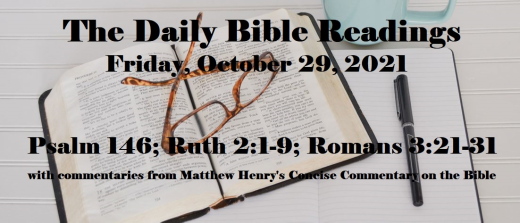
Friday, October 29, 2021
Psalm 146; Ruth 2:1-9; Romans 3:21-31
with commentaries from Matthew Henry's Concise Commentary on the Bible

Introduction

In today’s lectionary readings, the prophets of God become agents of miracles, showing holy love for those who have no refuge in society (Psalm 146). In our reading in Ruth, we meet Boaz. He is described as a man of standing in the community. He is also a good man but, importantly, a godly man. He greets his workers in the name of the LORD and has sufficiently backed up this lip service with his godly character that we clearly see. The workers had manners that came from their boss. They allowed Ruth to work freely. In our epistle reading, Paul begins with good news. The good news is there is hope. We can never get this righteousness on our own, but we can get it from God—justification by faith apart from works. In our verse of the day, Paul writes that as the Jewish people offered killed animals as sacrifices to God, Christians should instead offer ourselves, our bodies, to Him as living sacrifices. In other words, the only rational response to God’s mercy in giving us eternal life is to give Him our lives as a sacrifice to use for His purposes right now.

Today’s Verse of the Day:
Romans 12:1

Therefore, I urge you, brothers and sisters, in view of God’s mercy, to offer your bodies as a living sacrifice, holy and pleasing to God—this is your true and proper worship.
Many people accept Jesus Christ as their Savior and never learn how to live a life that honors Him. But Paul encourages us to turn ourselves over to God each day, lay our wills on the altar before Him, and ask Him to use us for His glory and the good of His people. In full trust and worship, we commit to obeying Him, knowing that the Lord knows how best to lead us—no matter what happens.

Today’s Lectionary Readings:
From the Psalter
Psalm 146
God Lifts Those Bowed Down

1 Praise the Lord.

  Praise the Lord, my soul.

2 I will praise the Lord all my life;
     I will sing praise to my God as long as I live.
3 Do not put your trust in princes,
     in human beings, who cannot save.
4 When their spirit departs, they return to the ground;
     on that very day their plans come to nothing.
5 Blessed are those whose help is the God of Jacob,
     whose hope is in the Lord their God.

6 He is the Maker of heaven and earth,
     the sea, and everything in them—
     he remains faithful forever.
7 He upholds the cause of the oppressed
     and gives food to the hungry.
  The Lord sets prisoners free,
8    the Lord gives sight to the blind,
  the Lord lifts up those who are bowed down,
     the Lord loves the righteous.
9 The Lord watches over the foreigner
     and sustains the fatherless and the widow,
     but he frustrates the ways of the wicked.

10 The Lord reigns forever,
      your God, O Zion, for all generations.

  Praise the Lord.


Commentary

Verses 1-4: If it is our delight to praise the Lord while we live, we shall certainly praise him to all eternity. With this glorious prospect before us, how low do worldly pursuits seem! There is a Son of man in whom there is help, even him who is also the Son of God, who will not fail those that trust in him. But all other sons of men are like the man from whom they sprung, who, being in honor, did not abide. God has given the earth to the children of men, but there is great striving about it. Yet, after a while, no part of the earth will be their own, except that in which their dead bodies are laid. And when man returns to his earth, in that very day all his plans and designs vanish and are gone: what then comes of expectations from him?

Verses 5-10: The psalmist encourages us to put confidence in God. We must hope in the providence of God for all we need as to this life, and in the grace of God for that which is to come. The God of heaven became a man that he might become our salvation. Though he died on the cross for our sins, and was laid in the grave, yet his thoughts of love to us did not perish; he rose again to fulfill them. When on earth, his miracles were examples of what he is still doing every day. He grants deliverance to captives bound in the chains of sin and Satan. He opens the eyes of the understanding. He feeds with the bread of life those who hunger for salvation; and he is the constant Friend of the poor in spirit, the helpless: with him poor sinners, that are as fatherless, find mercy; and his kingdom shall continue for ever. Then let sinners flee to him, and believers rejoice in him. And as the Lord shall reign for ever, let us stir up each other to praise his holy name.


From the Historical Books
Ruth 2:1-9
Ruth Meets Boaz

2:1 Now Naomi had a relative on her husband’s side, a man of standing from the clan of Elimelek, whose name was Boaz.

2 And Ruth the Moabite said to Naomi, “Let me go to the fields and pick up the leftover grain behind anyone in whose eyes I find favor.”

Naomi said to her, “Go ahead, my daughter.”
3 So she went out, entered a field and began to glean behind the harvesters. As it turned out, she was working in a field belonging to Boaz, who was from the clan of Elimelek.

4 Just then Boaz arrived from Bethlehem and greeted the harvesters, “The Lord be with you!”

“The Lord bless you!” they answered.

5 Boaz asked the overseer of his harvesters, “Who does that young woman belong to?”

6 The overseer replied, “She is the Moabite who came back from Moab with Naomi. 7 She said, ‘Please let me glean and gather among the sheaves behind the harvesters.’ She came into the field and has remained here from morning till now, except for a short rest in the shelter.”

8 So Boaz said to Ruth, “My daughter, listen to me. Don’t go and glean in another field and don’t go away from here. Stay here with the women who work for me. 9 Watch the field where the men are harvesting, and follow along after the women. I have told the men not to lay a hand on you. And whenever you are thirsty, go and get a drink from the water jars the men have filled.”

Commentary

Verses 1-3: Observe Ruth's humility. When Providence had made her poor, she cheerfully stoops to her lot. High spirits will rather starve than stoop; not so Ruth. Nay, it is her own proposal. She speaks humbly in her expectation of leave to glean. We may not demand kindness as a debt, but ask, and take it as a favor, though in a small matter. Ruth also was an example of industry. She loved not to eat the bread of idleness. This is an example to young people. Diligence promises well, both for this world and the other. We must not be shy of any honest employment. No labor is a reproach. Sin is a thing below us, but we must not think any thing else so, to which Providence call us. She was an example of regard to her mother, and of trust in Providence. God wisely orders what seem to us small events; and those that appear altogether uncertain, still are directed to serve his own glory, and the good of his people.

Verses 4-9: The pious and kind language between Boaz and his reapers shows that there were godly persons in Israel. Such language as this is seldom heard in our field; too often, on the contrary, what is immoral and corrupt. A stranger would form a very different opinion of our land, from that which Ruth would form of Israel from the converse and conduct of Boaz and his reapers. But true religion will teach a man to behave aright in all states and conditions; it will form kind masters and faithful servants, and cause harmony in families. True religion will cause mutual love and kindness among persons of different ranks. It had these effects on Boaz and his men. When he came to them he prayed for them. They did not, as soon as he was out of hearing curse him, as some ill-natured servants that hate their master's eye, but they returned his courtesy. Things are likely to go on well where there is such good-will as this between masters and servants. They expressed their kindness to each other by praying one for another. Boaz inquired concerning the stranger he saw, and ordered her to be well treated. Masters must take care, not only that they do no hurt themselves, but that they suffer not their servants and those under them to do wrong. Ruth humbly owned herself unworthy of favors, seeing she was born and brought up a heathen. It well becomes us all to think humbly of ourselves, esteeming others better than ourselves. And let us, in the kindness of Boaz to Ruth, note the kindness of the Lord Jesus Christ to poor sinners.


From the Epistles
Romans 3:21-31
Temple Sacrifices and Christ

3:21 But now apart from the law the righteousness of God has been made known, to which the Law and the Prophets testify. 22 This righteousness is given through faith in Jesus Christ to all who believe. There is no difference between Jew and Gentile, 23 for all have sinned and fall short of the glory of God, 24 and all are justified freely by his grace through the redemption that came by Christ Jesus. 25 God presented Christ as a sacrifice of atonement, through the shedding of his blood—to be received by faith. He did this to demonstrate his righteousness, because in his forbearance he had left the sins committed beforehand unpunished— 26 he did it to demonstrate his righteousness at the present time, so as to be just and the one who justifies those who have faith in Jesus.

27 Where, then, is boasting? It is excluded. Because of what law? The law that requires works? No, because of the law that requires faith. 28 For we maintain that a person is justified by faith apart from the works of the law. 29 Or is God the God of Jews only? Is he not the God of Gentiles too? Yes, of Gentiles too, 30 since there is only one God, who will justify the circumcised by faith and the uncircumcised through that same faith. 31 Do we, then, nullify the law by this faith? Not at all! Rather, we uphold the law.

Commentary

Verses 21-26: Must guilty man remain under wrath? Is the wound for ever incurable? No; blessed be God, there is another way laid open for us. This is the righteousness of God; righteousness of his ordaining, and providing, and accepting. It is by that faith which has Jesus Christ for its object; an anointed Savior, so Jesus Christ signifies. Justifying faith respects Christ as a Savior, in all his three anointed offices, as Prophet, Priest, and King; trusting in him, accepting him, and cleaving to him: in all these, Jews and Gentiles are alike welcome to God through Christ. There is no difference, his righteousness is upon all that believe; not only offered to them, but put upon them as a crown, as a robe. It is free grace, mere mercy; there is nothing in us to deserve such favors. It comes freely unto us, but Christ bought it, and paid the price. And faith has special regard to the blood of Christ, as that which made the atonement. God, in all this, declares his righteousness. It is plain that he hates sin, when nothing less than the blood of Christ would satisfy for it. And it would not agree with his justice to demand the debt, when the Surety has paid it, and he has accepted that payment in full satisfaction.

Verses 27-31: God will have the great work of the justification and salvation of sinners carried on from first to last, so as to shut out boasting. Now, if we were saved by our own works, boasting would not be excluded. But the way of justification by faith for ever shuts out boasting. Yet believers are not left to be lawless; faith is a law, it is a working grace, wherever it is in truth. By faith, not in this matter an act of obedience, or a good work, but forming the relation between Christ and the sinner, which renders it proper that the believer should be pardoned and justified for the sake of the Savior, and that the unbeliever who is not thus united or related to him, should remain under condemnation. The law is still of use to convince us of what is past, and to direct us for the future. Though we cannot be saved by it as a covenant, yet we own and submit to it, as a rule in the hand of the Mediator.



Today’s Lectionary Readings are selected from the Revised Common Lectionary Daily Readings, a three-year cyclical lectionary. We are currently in Year B. Beginning with the first Sunday of Advent in 2021, we will be in Year C. The year which ended at Advent 2020 was Year A. These readings complement the Sunday and festival readings: Thursday through Saturday readings help prepare the reader for the Sunday ahead; Monday through Wednesday readings help the reader reflect and digest what they heard in worship. Revised Common Lectionary Daily Readings, copyright © 2005 Consultation on Common Texts. www.commontexts.org. The Bible texts of the Old Testament, Epistle, and Gospel lessons are from The Holy Bible, New International Version®, NIV® Copyright ©1973, 1978, 1984, 2011 by Biblica, Inc.® Used by permission. All rights reserved worldwide. Commentaries from Matthew Henry's Concise Commentary on the Bible.

The Morning Prayer for Friday, October 29, 2021


The Morning Prayer
Friday, October 29, 2021


Blessed are those who have learned to acclaim you, who walk in the light of your presence, Lord. They rejoice in your name all day long; they celebrate your righteousness.
Psalm 89:15–16, NIV


Dear Father in heaven, how lovingly you have thought of us! How much good you let us experience again and again! So our hearts are happy, and we go to rest this night full of joy and thanks because we are your children. Our thanks and joy shall be our service to you day and night. More than this you do not ask, and in this we will be faithful. We want to be joyful and to be glad for our lives. Even when we face dark hours, O Lord our God, we are filled with hope that brings us joy for the future as well as for the present, with assurance that your salvation is coming. We rejoice in what you give us already today. Amen.

Verse of the Day for Friday, October 29, 2021


Verse of the Day
Friday, October 29, 2021


Romans 12:1
Therefore, I urge you, brothers and sisters, in view of God’s mercy, to offer your bodies as a living sacrifice, holy and pleasing to God—this is your true and proper worship.
Many people accept Jesus Christ as their Savior and never learn how to live a life that honors Him. But Paul encourages us to turn ourselves over to God each day, lay our wills on the altar before Him, and ask Him to use us for His glory and the good of His people. In full trust and worship, we commit to obeying Him, knowing that the Lord knows how best to lead us—no matter what happens.

Read all of Romans Chapter 12

Listen to Romans Chapter 12


Scripture from the Holy Bible, New International Version®, NIV®.

Our Daily Bread — God Sings Over You


God Sings Over You

[God] will rejoice over you with singing. Zephaniah 3:17

READ Zephaniah 3:14–17

Seventeen months after our first child—a boy—was born, along came a little girl. I was overjoyed at the thought of having a daughter, but I was also a bit uneasy because while I knew a few things about little boys, this was uncharted territory. We named her Sarah, and one of my privileges was rocking her to sleep so my wife could rest. I’m not sure why, but I started trying to sing her to sleep, and the song of choice was “You Are My Sunshine.” Whether holding her in my arms or standing above her in her crib, I quite literally sang over her, and loved every minute of it. She’s in her twenties now, and I still call her Sunshine.

We usually think about angels singing. But when was the last time you thought about God singing? That’s right—God singing. And furthermore, when was the last time you thought about Him singing over you? Zephaniah is clear in his message to Jerusalem: “The Lord your God” takes great delight in you, so much so that He “rejoice[s] over you with singing” (3:17). Although this message speaks directly to Jerusalem, it’s likely God sings over us—those who have received Jesus as Savior—too! What song does He sing? Well, Scripture’s not clear on that. But the song is born out of His love, so we can trust it’s true and noble and right and pure and lovely and admirable (Philippians 4:8).

By John Blase

REFLECT & PRAY

What feelings are stirred when you consider God singing over you? Is that something unbelievable or something comforting? Why?

Good Father, the thought that You would sing over me in joy is such an assurance and comfort. Thank You.

SCRIPTURE INSIGHT

While the book of Zephaniah (which means “the Lord hides/conceals”) ends on a note of joy and singing in view of God’s restoration (Zephaniah 3:14–20), the bulk of the book records God’s judgment on Judah and the nations. “The day of the Lord” is the primary theme (1:2–3:8). This term refers to a day when God settles accounts with those who oppose Him (a day of judgment) and rewards the remnant of faithful followers (a day of deliverance/salvation). Indeed, “the Mighty Warrior who saves [and] will take great delight in you” (3:17) is also “the Mighty Warrior [who] shouts his battle cry” (1:14). The sovereign God of all the earth has the right to call the nations into account.

Arthur Jackson

Wednesday, October 27, 2021

The Daily Bible Readings for Thursday, October 28, 2021


The Daily Bible Readings
Thursday, October 28, 2021
Psalm 146; Ruth 1:18-22; Hebrews 9:1-12
with commentaries from Matthew Henry's Concise Commentary on the Bible

Introduction

In today’s lectionary readings, the prophets of God become agents of miracles, showing holy love for those who have no refuge in society (Psalm 146). In our reading in Ruth,  Ruth follows Naomi to Bethlehem. It was a long walk from Moab to Bethlehem, and the trip was mostly uphill. We can imagine along the way, Ruth asking her mother-in-law Naomi all about the God of Israel and the land of Israel. In our epistle reading, the apostle shows the Hebrews the typical reference of their ceremonies to Christ. The tabernacle was a movable temple, shadowing forth the unsettled state of the church upon earth, and the human nature of the Lord Jesus Christ, in whom the fulness of the Godhead dwelt bodily. Our verse of the day uses a quotation from Isaiah 40:6b–8, a text that in Isaiah refers to human frailty versus the certainty of God’s promise of redemption.

Today’s Verse of the Day:
1 Peter 1:24-25

For, “All people are like grass, and all their glory is like the flowers of the field; the grass withers and the flowers fall, but the word of the Lord endures forever.” And this is the word that was preached to you.
This quotation in is from the Greek version of Isaiah 40:6b–8, a text that in Isaiah refers to human frailty versus the certainty of God’s promise of redemption, using images drawn from the hot desert wind’s withering the vegetation in its path. Peter is not the only New Testament writer to use this passage (cf. James 1:10–11), and it fits well in this context. While their experience of life under persecution might be that “the grass withers and the flowers fall,” it is really their pagan persecutors who “are like grass,” while they have been born of “the word of the Lord [that] stands forever. ” In an insecure world they have security through the power of the gospel.

Today’s Lectionary Readings:
From the Psalter
Psalm 146
God Lifts Those Bowed Down

1 Praise the Lord.

  Praise the Lord, my soul.

2 I will praise the Lord all my life;
     I will sing praise to my God as long as I live.
3 Do not put your trust in princes,
     in human beings, who cannot save.
4 When their spirit departs, they return to the ground;
     on that very day their plans come to nothing.
5 Blessed are those whose help is the God of Jacob,
     whose hope is in the Lord their God.

6 He is the Maker of heaven and earth,
     the sea, and everything in them—
     he remains faithful forever.
7 He upholds the cause of the oppressed
     and gives food to the hungry.
  The Lord sets prisoners free,
8    the Lord gives sight to the blind,
  the Lord lifts up those who are bowed down,
     the Lord loves the righteous.
9 The Lord watches over the foreigner
     and sustains the fatherless and the widow,
     but he frustrates the ways of the wicked.

10 The Lord reigns forever,
      your God, O Zion, for all generations.

  Praise the Lord.


Commentary

Verses 1-4: If it is our delight to praise the Lord while we live, we shall certainly praise him to all eternity. With this glorious prospect before us, how low do worldly pursuits seem! There is a Son of man in whom there is help, even him who is also the Son of God, who will not fail those that trust in him. But all other sons of men are like the man from whom they sprung, who, being in honor, did not abide. God has given the earth to the children of men, but there is great striving about it. Yet, after a while, no part of the earth will be their own, except that in which their dead bodies are laid. And when man returns to his earth, in that very day all his plans and designs vanish and are gone: what then comes of expectations from him?

Verses 5-10: The psalmist encourages us to put confidence in God. We must hope in the providence of God for all we need as to this life, and in the grace of God for that which is to come. The God of heaven became a man that he might become our salvation. Though he died on the cross for our sins, and was laid in the grave, yet his thoughts of love to us did not perish; he rose again to fulfill them. When on earth, his miracles were examples of what he is still doing every day. He grants deliverance to captives bound in the chains of sin and Satan. He opens the eyes of the understanding. He feeds with the bread of life those who hunger for salvation; and he is the constant Friend of the poor in spirit, the helpless: with him poor sinners, that are as fatherless, find mercy; and his kingdom shall continue for ever. Then let sinners flee to him, and believers rejoice in him. And as the Lord shall reign for ever, let us stir up each other to praise his holy name.


From the Historical Books
Ruth 1:18-22
Ruth and Naomi

1:18 When Naomi realized that Ruth was determined to go with her, she stopped urging her.

19 So the two women went on until they came to Bethlehem. When they arrived in Bethlehem, the whole town was stirred because of them, and the women exclaimed, “Can this be Naomi?”

20 “Don’t call me Naomi,” she told them. “Call me Mara, because the Almighty has made my life very bitter. 21 I went away full, but the Lord has brought me back empty. Why call me Naomi? The Lord has afflicted me; the Almighty has brought misfortune upon me.”

22 So Naomi returned from Moab accompanied by Ruth the Moabite, her daughter-in-law, arriving in Bethlehem as the barley harvest was beginning.

Commentary

Naomi and Ruth came to Bethlehem. Afflictions will make great and surprising changes in a little time. May God, by his grace, fit us for all such changes, especially the great change!, Naomi signifies "pleasant," or "amiable;" Mara, "bitter," or "bitterness." She was now a woman of a sorrowful spirit. She had come home empty, poor, a widow and childless. But there is a fullness for believers of which they never can be emptied; a good part which shall not be taken from those who have it. The cup of affliction is a "bitter" cup, but she owns that the affliction came from God. It well becomes us to have our hearts humbled under humbling providences. It is not affliction itself, but affliction rightly borne, that does us good.

From the Epistles
Hebrews 9:1-12
Temple Sacrifices and Christ

9:1 Now the first covenant had regulations for worship and also an earthly sanctuary. 2 A tabernacle was set up. In its first room were the lampstand and the table with its consecrated bread; this was called the Holy Place. 3 Behind the second curtain was a room called the Most Holy Place, 4 which had the golden altar of incense and the gold-covered ark of the covenant. This ark contained the gold jar of manna, Aaron’s staff that had budded, and the stone tablets of the covenant. 5 Above the ark were the cherubim of the Glory, overshadowing the atonement cover. But we cannot discuss these things in detail now.

6 When everything had been arranged like this, the priests entered regularly into the outer room to carry on their ministry. 7 But only the high priest entered the inner room, and that only once a year, and never without blood, which he offered for himself and for the sins the people had committed in ignorance. 8 The Holy Spirit was showing by this that the way into the Most Holy Place had not yet been disclosed as long as the first tabernacle was still functioning. 9 This is an illustration for the present time, indicating that the gifts and sacrifices being offered were not able to clear the conscience of the worshiper. 10 They are only a matter of food and drink and various ceremonial washings—external regulations applying until the time of the new order.

11 But when Christ came as high priest of the good things that are now already here, he went through the greater and more perfect tabernacle that is not made with human hands, that is to say, is not a part of this creation. 12 He did not enter by means of the blood of goats and calves; but he entered the Most Holy Place once for all by his own blood, thus obtaining eternal redemption.

Commentary
Verses 1-5: The apostle shows to the Hebrews the typical reference of their ceremonies to Christ. The tabernacle was a movable temple, shadowing forth the unsettled state of the church upon earth, and the human nature of the Lord Jesus Christ, in whom the fullness of the Godhead dwelt bodily. The typical meaning of these things has been shown in former remarks, and the ordinances and articles of the Mosaic covenant point out Christ as our Light, and as the Bread of life to our souls; and remind us of his Divine Person, his holy priesthood, perfect righteousness, and all-prevailing intercession. Thus was the Lord Jesus Christ, all and in all, from the beginning. And as interpreted by the gospel, these things are a glorious representation of the wisdom of God, and confirm faith in Him who was prefigured by them.

Verses 6-10: The apostle goes on to speak of the Old Testament services. Christ, having undertaken to be our High Priest, could not enter into heaven till he had shed his blood for us; and none of us can enter, either into God's gracious presence here, or his glorious presence hereafter, but by the blood of Jesus. Sins are errors, great errors, both in judgment and practice; and who can understand all his errors? They leave guilt upon the conscience, not to be washed away but by the blood of Christ. We must plead this blood on earth, while he is pleading it for us in heaven. A few believers, under the Divine teaching, saw something of the way of access to God, of communion with him, and of admission into heaven through the promised Redeemer, but the Israelites in general looked no further than the outward forms. These could not take away the defilement or dominion of sin. They could neither discharge the debts, nor resolve the doubts, of him who did the service. Gospel times are, and should be, times of reformation, of clearer light as to all things needful to be known, and of greater love, causing us to bear ill-will to none, but good-will to all. We have greater freedom, both of spirit and speech, in the gospel, and greater obligations to a more holy living.

Verses 11-12: All good things past, present, and to come, were and are founded upon the priestly office of Christ, and come to us from thence. Our High Priest entered into heaven once for all, and has obtained eternal redemption. The Holy Ghost further signified and showed that the Old Testament sacrifices only freed the outward man from ceremonial uncleanness, and fitted him for some outward privileges. What gave such power to the blood of Christ? It was Christ's offering himself without any sinful stain in his nature or life. This cleanses the most guilty conscience from dead, or deadly, works to serve the living God; from sinful works, such as pollute the soul, as dead bodies did the persons of the Jews who touched them; while the grace that seals pardon, new-creates the polluted soul. Nothing more destroys the faith of the gospel, than by any means to weaken the direct power of the blood of Christ. The depth of the mystery of the sacrifice of Christ, we cannot dive into, the height we cannot comprehend. We cannot search out the greatness of it, or the wisdom, the love, the grace that is in it. But in considering the sacrifice of Christ, faith finds life, food, and refreshment.


Today’s Lectionary Readings are selected from the Revised Common Lectionary Daily Readings, a three-year cyclical lectionary. We are currently in Year B. Beginning with the first Sunday of Advent in 2021, we will be in Year C. The year which ended at Advent 2020 was Year A. These readings complement the Sunday and festival readings: Thursday through Saturday readings help prepare the reader for the Sunday ahead; Monday through Wednesday readings help the reader reflect and digest what they heard in worship. Revised Common Lectionary Daily Readings, copyright © 2005 Consultation on Common Texts. www.commontexts.org. The Bible texts of the Old Testament, Epistle, and Gospel lessons are from The Holy Bible, New International Version®, NIV® Copyright ©1973, 1978, 1984, 2011 by Biblica, Inc.® Used by permission. All rights reserved worldwide. Commentaries from Matthew Henry's Concise Commentary on the Bible.

The Morning Prayer for Thursday, October 28, 2021


The Morning Prayer
Thursday, October 28, 2021


Sacrifice thank offerings to God, fulfill your vows to the Most High, and call on me in the day of trouble; I will deliver you, and you will honor me.
Psalm 50:14–15, NIV


Dear Father in heaven, we want to praise you together and to thank you with all our hearts for your goodness and your deliverance from our many needs. Accept our thanks, and help us go on our way with ever joyful hearts. Make us ready for whatever you have prepared for us, your children. Bless us in our individual lives and bless us in our community. Let your Spirit shed its rays into all places to comfort people's hearts and to restore and strengthen their faith. May your name be praised forevermore. Amen.

Verse of the Day for Thursday, October 28, 2021


Verse of the Day
Thursday, October 28, 2021


1 Peter 1:24-25
For, “All people are like grass, and all their glory is like the flowers of the field; the grass withers and the flowers fall, but the word of the Lord endures forever.” And this is the word that was preached to you.
This quotation in is from the Greek version of Isaiah 40:6b–8, a text that in Isaiah refers to human frailty versus the certainty of God’s promise of redemption, using images drawn from the hot desert wind’s withering the vegetation in its path. Peter is not the only New Testament writer to use this passage (cf. James 1:10–11), and it fits well in this context. While their experience of life under persecution might be that “the grass withers and the flowers fall,” it is really their pagan persecutors who “are like grass,” while they have been born of “the word of the Lord [that] stands forever. ” In an insecure world they have security through the power of the gospel.

Read all of First Peter Chapter 1

Listen to First Peter Chapter 1


Scripture from the Holy Bible, New International Version®, NIV®.

Our Daily Bread — Is God Listening?


Is God Listening?

If we ask anything according to his will, he hears us. 1 John 5:14

READ 1 John 5:13–15

When I served on my church’s congregational care team, one of my duties was to pray over the requests penciled on pew cards during the services. For an aunt’s health. For a couple’s finances. For a grandson’s discovery of God. Rarely did I hear the results of these prayers. Most were anonymous, and I had no way of knowing how God had responded. I confess that at times I wondered, Was He really listening? Was anything happening as a result of my prayers?

Over our lifetimes, most of us question, “Does God hear me?” I remember my own Hannah-like pleas for a child that went unanswered for years. And there were my pleas that my father find faith, yet he died without any apparent confession.

Etched across the millennia are myriad instances of God’s ear bending to listen: to Israel’s groans under slavery (Exodus 2:24); to Moses on Mount Sinai (Deuteronomy 9:19); to Joshua at Gilgal (Joshua 10:14); to Hannah’s prayers for a child (1 Samuel 1:10–17); to David crying out for deliverance from Saul (2 Samuel 22:7).

First John 5:14 crescendos, “If we ask anything according to his will, he hears us.” The word for “hears” means to pay attention and to respond on the basis of having heard.

As we go to God today, may we have the confidence of His listening ear spanning the history of His people. He hears our pleas.

By Elisa Morgan

REFLECT & PRAY

Pause to consider what you’ve most recently asked of God. What motivated you to ask? How can you know that God hears you?

Father, I come asking and trusting You to hear me because You say that You do.

SCRIPTURE INSIGHT

In 1 John 5:14–15, we find a conditional promise for answered prayer: God hears our prayers and gives us what we ask for when “we ask anything according to his will.” To pray according to God’s will is to “ask for anything that pleases him” (nlt) or “in accord with his own plan” (J. B. Phillips). The psalmist, painfully aware that God’s promise of answered prayer is conditioned upon a right relationship with Him, cautioned, “If I had cherished sin in my heart, the Lord would not have listened” (Psalm 66:18). The apostle James warns that God won’t give us what we pray for when we “ask with wrong motives, that [we] may spend what [we] get on [our] pleasures” (James 4:3). A right relationship with Jesus is required: “If you remain in me and my words remain in you, ask whatever you wish, and it will be done for you” (John 15:7).

K. T. Sim

Tuesday, October 26, 2021

The Daily Bible Readings for Wednesday, October 27, 2021

 
The word of God is sharper than any double-edged sword

The Daily Bible Readings
Wednesday, October 27, 2021
Psalm 28; Ezekiel 14:12-23; Matthew 20:29-34
with commentaries from Matthew Henry's Concise Commentary on the Bible

Introduction

In today’s lectionary readings, our psalm reading is a lament psalm. In it, David is working through a very troubling reality in his life with the Lord’s help. And that troubling reality involves wicked men. Their presence and activities may very well call for national judgment. In our reading in Ezekiel,  we learn the impossibility of Jerusalem surviving divine punishment from the example of 3 men whom God picked out to emphasize their loyalty and righteousness. In our gospel reading, we hear an account of the cure of two poor blind beggars that Jesus heals. Our verse of the day is probably among the most-quoted verses in the Bible and a highlight of the book of Hebrews. The context of this verse is crucial. In this, we are reminded that the Word gives us all the power we need to learn the true will of God.

Today’s Verse of the Day:
Hebrews 4:12

For the word of God is alive and active. Sharper than any double-edged sword, it penetrates even to dividing soul and spirit, joints and marrow; it judges the thoughts and attitudes of the heart.
The Bible lives, both because the Lord brought it into existence and because His Spirit brings its message to life in our hearts. It has His power to transform our lives and to keep us steadfastly anchored to Him when the storms of life strike. No other book in history has the inspiration, truth, and power of the Word of God.

Today’s Lectionary Readings:
From the Psalter
Psalm 28
God my Strength and Shield

1 To you, Lord, I call;
     you are my Rock,
     do not turn a deaf ear to me.
  For if you remain silent,
     I will be like those who go down to the pit.
2 Hear my cry for mercy
     as I call to you for help,
  as I lift up my hands
     toward your Most Holy Place.

3 Do not drag me away with the wicked,
     with those who do evil,
  who speak cordially with their neighbors
     but harbor malice in their hearts.
4 Repay them for their deeds
     and for their evil work;
  repay them for what their hands have done
     and bring back on them what they deserve.

5 Because they have no regard for the deeds of the Lord
     and what his hands have done,
  he will tear them down
     and never build them up again.

6 Praise be to the Lord,
     for he has heard my cry for mercy.
7 The Lord is my strength and my shield;
     my heart trusts in him, and he helps me.
  My heart leaps for joy,
     and with my song I praise him.

8 The Lord is the strength of his people,
     a fortress of salvation for his anointed one.
9 Save your people and bless your inheritance;
     be their shepherd and carry them forever.


Commentary

Verses 1-5: David is very earnest in prayer. Observe his faith in prayer; God is my rock, on whom I build my hope. Believers should not rest till they have received some token that their prayers are heard. He prays that he may not be numbered with the wicked. Save me from being entangled in the snares they have laid for me. Save me from being infected with their sins, and from doing as they do. Lord, never leave me to use such arts of deceit and treachery for my safety, as they use for my ruin. Believers dread the way of sinners; the best are sensible of the danger they are in of being drawn aside: we should all pray earnestly to God for his grace to keep us. Those who are careful not to partake with sinners in their sins, have reason to hope that they shall not receive their plagues. He speaks of the just judgments of the Lord on the workers of iniquity, ver. Psalms 28:4. This is not the language of passion or revenge. It is a prophecy that there will certainly come a day, when God will punish every man who persists in his evil deeds. Sinners shall be reckoned with, not only for the mischief they have done, but for the mischief they designed, and did what they could to effect. Disregard of the works of the Lord, is the cause of the sin of sinners, and becomes the cause of their ruin.

Verses 6-9: Has God heard our supplications? Let us then bless his name. The Lord is my strength, to support me, and carry me on through all my services and sufferings. The heart that truly believes, shall in due time greatly rejoice: we are to expect joy and peace in believing. God shall have the praise of it: thus must we express our gratitude. The saints rejoice in others' comfort as well as their own: we have the less benefit from the light of the sun, nor from the light of God's countenance, for others' sharing therein. The psalmist concludes with a short, but comprehensive prayer. God's people are his inheritance, and precious in his eyes. He prays that God would save them; that he would bless them with all good, especially the plenty of his ordinances, which are food to the soul. And direct their actions and overrule their affairs for good. Also, lift them up for ever; not only those of that age, but his people in every age to come; lift them up as high as heaven. There, and there only, will saints be lifted up for ever, never more to sink, or be depressed. Save us, Lord Jesus, from our sins; bless us, thou Son of Abraham, with the blessing of righteousness; feed us, thou good Shepherd of the sheep, and lift us up for ever from the dust, O thou, who art the Resurrection and the Life.


From the Prophetic Books
Ezekiel 14:12-23
Job an Example of Righteousness

14:12 The word of the Lord came to me: 13 “Son of man, if a country sins against me by being unfaithful and I stretch out my hand against it to cut off its food supply and send famine upon it and kill its people and their animals, 14 even if these three men—Noah, Daniel and Job—were in it, they could save only themselves by their righteousness, declares the Sovereign Lord.

15 “Or if I send wild beasts through that country and they leave it childless and it becomes desolate so that no one can pass through it because of the beasts, 16 as surely as I live, declares the Sovereign Lord, even if these three men were in it, they could not save their own sons or daughters. They alone would be saved, but the land would be desolate.

17 “Or if I bring a sword against that country and say, ‘Let the sword pass throughout the land,’ and I kill its people and their animals, 18 as surely as I live, declares the Sovereign Lord, even if these three men were in it, they could not save their own sons or daughters. They alone would be saved.

19 “Or if I send a plague into that land and pour out my wrath on it through bloodshed, killing its people and their animals, 20 as surely as I live, declares the Sovereign Lord, even if Noah, Daniel and Job were in it, they could save neither son nor daughter. They would save only themselves by their righteousness.

21 “For this is what the Sovereign Lord says: How much worse will it be when I send against Jerusalem my four dreadful judgments—sword and famine and wild beasts and plague—to kill its men and their animals! 22 Yet there will be some survivors—sons and daughters who will be brought out of it. They will come to you, and when you see their conduct and their actions, you will be consoled regarding the disaster I have brought on Jerusalem—every disaster I have brought on it. 23 You will be consoled when you see their conduct and their actions, for you will know that I have done nothing in it without cause, declares the Sovereign Lord.”

Commentary

National sins bring national judgments. Though sinners escape one judgment, another is waiting for them. When God's professing people rebel against him, they may justly expect all his judgments. The faith, obedience, and prayers of Noah prevailed to the saving of his house, but not of the old world. Job's sacrifice and prayer in behalf of his friends were accepted, and Daniel had prevailed for the saving his companions and the wise men of Babylon. But a people that had filled the measure of their sins, was not to expect to escape for the sake of any righteous men living among them; not even of the most eminent saints, who could be accepted in their own case only through the sufferings and righteousness of Christ. Yet even when God makes the greatest desolations by his judgments, he saves some to be monuments of his mercy. In firm belief that we shall approve the whole of God's dealings with ourselves, and with all mankind, let us silence all rebellious murmurs and objections.

From the Gospels
Matthew 20:29-34
Jesus Heals Two Who Are Blind

20:29 As Jesus and his disciples were leaving Jericho, a large crowd followed him. 30 Two blind men were sitting by the roadside, and when they heard that Jesus was going by, they shouted, “Lord, Son of David, have mercy on us!”

31 The crowd rebuked them and told them to be quiet, but they shouted all the louder, “Lord, Son of David, have mercy on us!”

32 Jesus stopped and called them. “What do you want me to do for you?” he asked.

33 “Lord,” they answered, “we want our sight.”

34 Jesus had compassion on them and touched their eyes. Immediately they received their sight and followed him.

Commentary
It is good for those under the same trial, or infirmity of body or mind, to join in prayer to God for relief, that they may quicken and encourage one another. There is mercy enough in Christ for all that ask. They were earnest in prayer. They cried out as men in earnest. Cold desires beg denials. They were humble in prayer, casting themselves upon, and referring themselves cheerfully to, the Mediator's mercy. They showed faith in prayer, by the title they gave to Christ. Surely it was by the Holy Ghost that they called Jesus, Lord. They persevered in prayer. When they were in pursuit of such mercy, it was no time for timidity or hesitation: they cried earnestly. Christ encouraged them. The wants and burdens of the body we are soon sensible of, and can readily relate. Oh that we did as feelingly complain of our spiritual maladies, especially our spiritual blindness! Many are spiritually blind, yet say they see. Jesus cured these blind men; and when they had received sight, they followed him. None follow Christ blindly. He first by his grace opens men's eyes, and so draws their hearts after him. These miracles are our call to Jesus; may we hear it, and make it our daily prayer to grow in grace and in the knowledge of the Lord and Savior Jesus Christ.


Today’s Lectionary Readings are selected from the Revised Common Lectionary Daily Readings, a three-year cyclical lectionary. We are currently in Year B. Beginning with the first Sunday of Advent in 2021, we will be in Year C. The year which ended at Advent 2020 was Year A. These readings complement the Sunday and festival readings: Thursday through Saturday readings help prepare the reader for the Sunday ahead; Monday through Wednesday readings help the reader reflect and digest what they heard in worship. Revised Common Lectionary Daily Readings, copyright © 2005 Consultation on Common Texts. www.commontexts.org. The Bible texts of the Old Testament, Epistle, and Gospel lessons are from The Holy Bible, New International Version®, NIV® Copyright ©1973, 1978, 1984, 2011 by Biblica, Inc.® Used by permission. All rights reserved worldwide. Commentaries from Matthew Henry's Concise Commentary on the Bible.